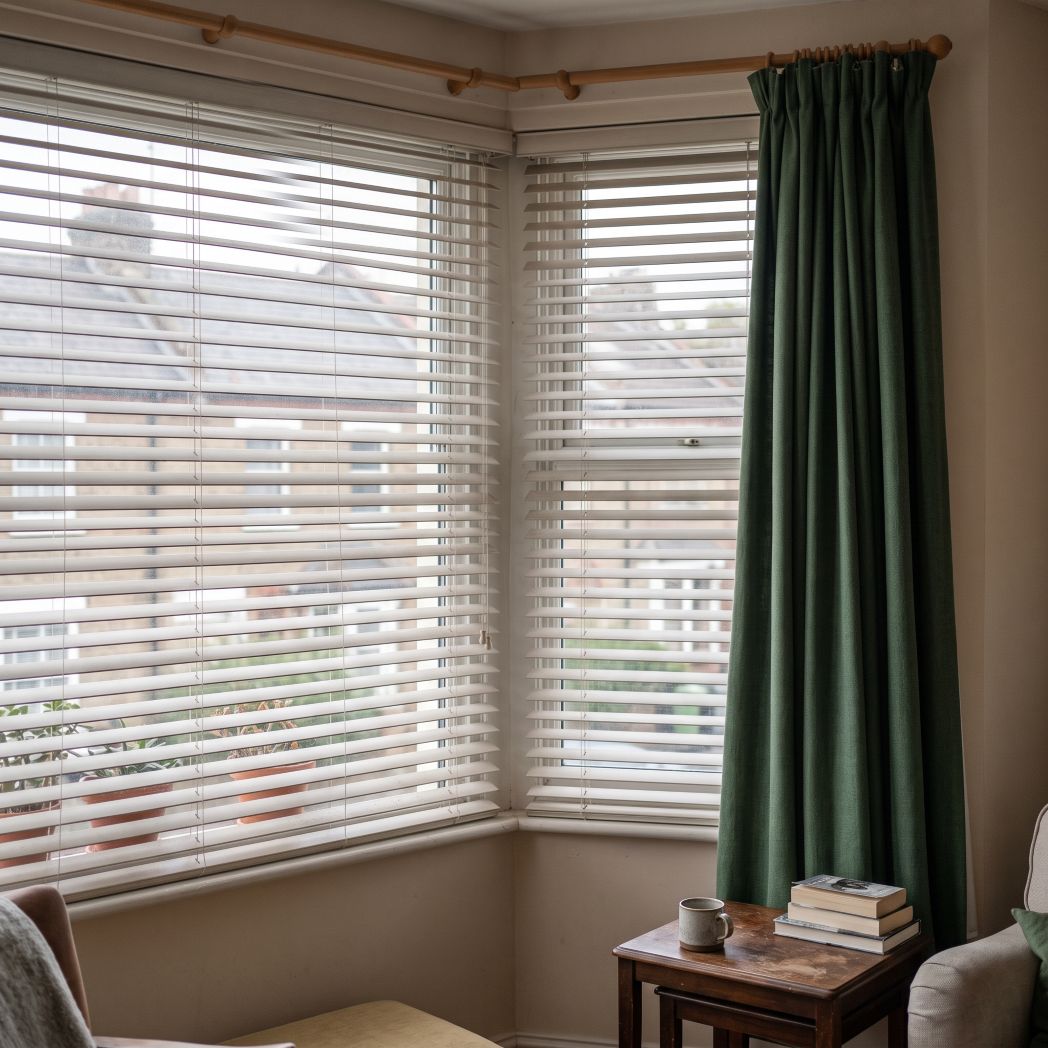
Curtains are the dirtiest thing in most London homes and the last thing anyone thinks about. They hang for eight years, nobody touches them, and then somebody takes them down to paint and finds the folds are two shades lighter than the flat faces. At that point the damage is done.
What is the grey film on the inside of your curtains?
Road dirt, mostly. Brake dust, tyre particles, diesel soot off the street, cooking grease that travelled from the kitchen, skin cells, and the general dust that any occupied room produces. It arrives as an oily film rather than loose dust, which is why it sticks and why a good shake does nothing.
The lining takes the worst of it because it faces the window. Sash windows in a Camberwell Grove flat leak air constantly – that’s their nature, and it’s why the room breathes – and every bit of air coming past the frame passes through the fabric on its way in. The curtain is a filter. It has been doing that job for years without being changed.
Hold it up to the light. A curtain lining that’s still doing its job blocks most of it. One that’s loaded with soot goes translucent-grey and you can see the weave, and the fabric will feel slightly stiff between finger and thumb, almost papery.
Why the top third is always the worst
Heat rises, and so does everything travelling in it. Grease from the kitchen, dust off the carpet, smoke from a candle – all of it goes up and gets caught in the heading and the top of the drop where the fabric is bunched tightest.
That’s also where the pleats are, and where a vacuum brush rarely reaches. Take the curtains down twice a year, hook the heading over the shower rail, and run the upholstery tool over both faces from the top down. Fifteen minutes a pair and it removes the loose material before it turns greasy.
Condensation mould on a lining is a different problem and doesn’t respond to any of this. Black spotting along the bottom 30cm means the fabric has been sitting against cold glass in a wet room, and washing it will fade the mark without removing it. Fix the window before you touch the curtain.
Can you machine-wash curtains, or will you ruin them?
Depends entirely on what they are, and most people guess wrong.
Unlined cotton or polyester, standard shop-bought, no interlining: yes, cool wash, gentle cycle, hang damp and let the weight of the water pull them straight. Voiles and nets: yes, and they come up better than people expect with a short wash and no spin. Add a scoop of oxygen bleach for nets that have gone yellow rather than grey, which is age and sunlight rather than dirt. A terrace on Fortis Green had nets nobody had washed since the previous owner and two of the four went into holes in the machine – old polyester perishes and you find out the hard way. Lined curtains where the lining is stitched in: risky, because the two fabrics shrink at different rates and you get puckering along the seams that no amount of ironing fixes.
Interlined curtains, velvet, silk, anything with a bump layer or a pattern repeat that cost real money: don’t. That’s a specialist job and it’s the one case where paying is obviously right.
Blackout linings are their own trap. The blackout is an acrylic coating on the back of the fabric, and hot water and agitation crack it. You’ll get a wash where everything looks fine coming out and then, over the next three months, the coating flakes off in the folds and drops white specks onto the sill.
The shrinkage you don’t get back
Cotton curtains shrink between two and five per cent on a first hot wash. On a 240cm drop, five per cent is 12cm. That’s a curtain that used to touch the floor now hanging above the radiator, and there’s no getting it back – you can let a hem down if there’s fabric in it, and on cheap ready-mades there usually isn’t.
Cold wash, and hang them wet rather than tumbling. If they’ve already shrunk, a steamer while they’re hanging will recover a little, though not much. A flat on Leigham Court Road in Streatham had a pair of heavy cotton curtains washed at 40 by a well-meaning house-sitter and they came up 9cm short. The owner ended up buying a new pair.
Test the water first with the tape, not the fabric. Curtain heading tape is nearly always cotton and it shrinks harder than whatever it’s sewn to, and puckered tape ruins the hang of an otherwise fine curtain. Pull the cords out before washing, always.
What’s the right way to clean venetian and vertical blinds?
Dust dry before you go anywhere near water. Wet-wiping a dusty slat makes grey streaks that then need doing twice.
Close the slats flat one way, run a microfibre or a proper blind duster along the whole run, then close them the other way and repeat. Both faces, every time. For an aluminium venetian in a kitchen, where there’s grease in the dust, follow with a cloth barely damp with washing-up liquid solution and dry the slats behind you as you go.
Wooden and faux-wood blinds want as little moisture as possible. Real wood swells, warps and then never closes properly again. Faux-wood is PVC and takes water fine, and it’s the better choice for a bathroom in Bexleyheath or any north-facing kitchen where condensation is a fact of life.
Vertical blind louvres unclip from the headrail and most fabric ones can be sponged flat on a table, or laid in a bath of lukewarm water with a little detergent for twenty minutes. Do not put them in the machine. They have a stiffener in them – a resin finish or a glass-fibre backing – and washing takes it out, after which they hang like tea towels.
The slat that snaps
Aluminium venetians break at the ladder cord, and the way people break them is by pinching a slat hard while wiping it. Support underneath with your other hand. Replacement slats exist for the common widths, and a 25mm aluminium slat is a couple of pounds, though matching a colour from a blind fitted eleven years ago in a flat on Churchfield Road in Acton turned out to be impossible – we ended up moving a slat from the bottom of the run, where nobody looks, up to eye level.
If you’ve got a whole flat of filthy venetians, there are firms with ultrasonic tanks who take them away and bring them back looking new, and it’s about £15 to £25 a blind in most of Greater London. For a wide 180cm kitchen blind that’s worth doing. For a £22 blind from Argos in a spare room, it isn’t, and I’d say so before quoting.
Why do roller and Roman blinds resist cleaning?
Because they’re built not to be cleaned, whatever the label says.
A roller blind is fabric that’s been stiffened with a coating so it holds its shape on the tube. Wash it, and the coating goes, and the blind curls at the edges and stops rolling straight. Spot-clean only: a damp cloth, unroll it fully, work on the mark, let it dry completely before rolling back up. Roll a damp blind and you’ll get a tide line across the full width.
Roman blinds have rods, cords and a lining sewn in, and they’re the one type I regularly tell people to leave to a specialist or leave alone. The cords run through eyelets and rings, and a wash shrinks the lining against the face fabric so the folds stop stacking evenly.
Kitchen roller blinds in particular reach a point of no return. Grease and steam yellow the PVC coating and it doesn’t reverse. Hold it to the light and if the fabric has gone the colour of weak tea across the whole drop rather than in patches, you’re looking at a replacement.
When replacing beats cleaning
This one costs my company money to say: a large share of the roller blinds we’re asked about should be binned. A made-to-measure roller for a standard London sash is £40 to £70 fitted. A specialist clean, if you can find someone who’ll take one on, is not far off that, and you’ll be doing it again in two years to a blind that’s already six years old.
Curtains are the opposite. A good pair of lined curtains is worth several hundred pounds and worth cleaning properly. Spend the money on the curtains, replace the blinds.
What should you pay somebody to do, and what should you handle yourself?
Yourself: the twice-yearly vacuum of everything, dry-dusting of all slats, spot-cleaning marks as they happen, and washing anything unlined and machine-safe.
Worth paying for: interlined, silk, velvet or valuable curtains, going to a firm that does curtain cleaning specifically rather than a high-street dry cleaner who’ll send them out anyway. Ultrasonic blind cleaning for large or numerous venetians. Rehanging, if the poles are above stairs – a curtain job in a maisonette on Orford Road took us a day mostly because of the stairwell drop and the ladder work.
What “cleaned in situ” gets you
Some firms steam-clean curtains while they hang. It refreshes them, takes out some odour, and it will not remove the embedded soot in the lining, because there’s nothing to extract into.
It’s the right service for one situation: heavy, interlined curtains that would shrink or lose their hang if taken down and washed, where you want them freshened rather than cleaned. Sold as an alternative to a proper clean, it’s a poor deal.
Hold the lining to the light before and after. That tells you what you paid for.