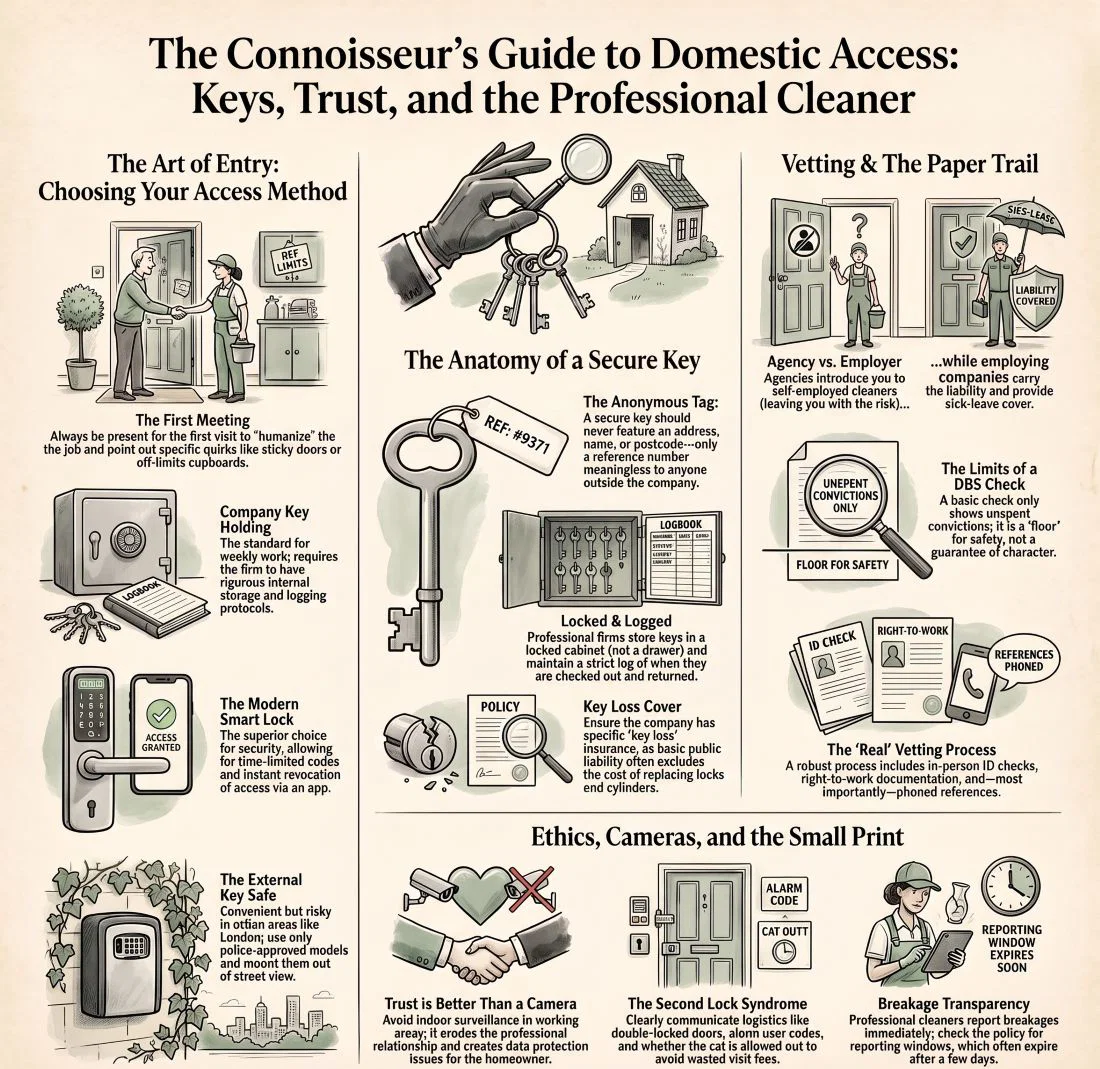
Handing over a key to your home is a bigger decision than choosing who cleans it, and most people make the second decision carefully and the first one on a doorstep in thirty seconds. We’ve been handed keys in Sainsbury’s car parks. We’ve had them posted through our office letterbox in an envelope with the full address written on the back.
Whoever you book, the questions below are the ones worth asking, and any company that finds them irritating has told you something useful.
How should a cleaner get into your home when you’re out?
Four options, and they suit different people.
Be there for the first visit at least. This is the one I push hardest and it costs you an hour. You meet the person, you walk them round, you point out the things that matter – the stripped floorboards, the door that sticks, the cupboard that isn’t part of the job – and they get a face and a name rather than a set of written instructions. Nearly every access problem we’ve had traces back to a job that started with nobody home.
Company key holding, where the firm keeps a set between visits. Convenient, standard for regular weekly work, and the one that needs the most care in setting up.
A key safe by the door. Popular, and I’m lukewarm on them for London houses. The mechanical push-button ones on the front of a terrace on Sandycombe Road in Kew tell anyone walking past that there’s a key in there and that the owner is often out, and the cheap ones come off a brick wall with a claw hammer. If you’re using one, get a police-approved model, mount it out of sight of the street, and change the code when a cleaner leaves.
Smart locks with a time-limited code. Best of the lot if your door will take one. You issue a code that works Tuesdays between nine and one, you get a log of every entry, and you revoke it in ten seconds when the arrangement ends.
What goes on the key tag
Nothing. No address, no flat number, no postcode, no surname.
A properly run company tags keys with a reference number that means nothing to anyone outside the office, keeps them in a locked cabinet rather than a drawer, and logs them out and back in on the day. Ask to be told how yours are stored. Get that in writing on the booking confirmation, because a verbal assurance from whoever answered the phone is worth very little at three in the morning when a bag has been stolen from a car in Kilburn.
Ask also who else has access to the key cabinet, and what happens to your key when your regular cleaner is off sick.
What should you ask about insurance before anyone gets a key?
Three things, and the answers are quick.
Public liability, which covers damage the cleaner does to your property. Most domestic firms carry between one and five million. The figure matters less than whether the policy is current, so ask for the certificate rather than the number – any real company can email it the same day.
Treatment or key loss cover, which is separate and which a lot of firms don’t have. This is the one that pays for a locksmith and new cylinders if your keys go missing. It is specifically excluded from many basic policies.
Employer’s liability, if the company employs its cleaners. That’s a legal requirement for employers in the UK and it protects the cleaner, though it matters to you too, because a company that skips it is skipping other things.
Employed, self-employed, and who carries the risk
This is the part nobody explains and it changes everything about what happens when there’s a problem.
An agency model puts you in a direct arrangement with a self-employed cleaner and takes a fee for the introduction. The agency’s insurance may cover very little. An employing company sends its own staff, carries the liability, and handles the replacement when someone’s ill. The hourly rates look similar on a comparison site and they are not the same product.
Ask which one you’re buying. A flat in Gidea Park where the “company” turned out to be a introduction service found that out after a granite worktop got a bleach mark on it, and the resolution took four months.
Get that in writing too. It should be in the terms, and if the terms are a WhatsApp message, that’s your answer.
What does vetting involve, and what does it prove?
Less than most people assume, and it’s still worth doing.
A decent process is: photo ID checked in person against the person standing there, proof of address, right-to-work documentation, two contactable references that somebody has phoned rather than read, and a criminal record check. Trial period supervised by a team leader. That’s the standard, and the reference calls are the part that gets skipped most often because they take twenty minutes each and half the numbers don’t answer.
Right to work is worth caring about for a selfish reason as well as an ethical one. A cleaner without the right to work in the UK has no recourse if they’re hurt in your home and no employer standing behind them if something goes wrong, and you may find yourself in a conversation you didn’t expect to be in.
The basic DBS and its limits
Domestic cleaning isn’t a regulated activity, so a basic check is what’s available – it’s the level anyone can apply for themselves through GOV.UK for a fixed fee, and it shows unspent convictions only.
What it doesn’t show: spent convictions, cautions in most cases, anything alleged and not charged, or anything that happened last week. A certificate dated three years ago tells you about a person as they were three years ago. Firms that advertise “fully DBS checked” and mean a single check on the day of hiring are being a bit generous with the phrasing.
It’s a floor. References and a visible, contactable office matter more – a landline that a person answers, an address you could turn up at, a company number you can look up on Companies House in forty seconds. Ask when the check was last renewed and get that in writing, because a firm that renews annually will be pleased to tell you and a firm that doesn’t will change the subject.
What happens when something breaks, goes missing, or a key is lost?
Breakages happen. Anyone who has cleaned houses for a living has broken something, and the companies worth using tell you the same day rather than waiting for you to notice.
Find out before you book: is there an excess, how are claims handled, what’s the time limit for reporting. Most policies want damage reported within a few days. Leave it three weeks and you’re outside the window.
For theft allegations, be careful in both directions. A cleaner is the obvious suspect and frequently the wrong one, and I’ve had two accusations over the years that resolved themselves – earrings behind a radiator on Springbank Road, a ring that had gone to the dry cleaner’s in a coat pocket. Look properly first. If something has gone, it’s a police matter and the company should cooperate fully, and any company that goes quiet at that point has failed you.
Who pays for the lock change
Whoever lost the key, in principle. In practice it depends on whether the firm has key cover and whether their terms cap it.
Ask what happens if the key is lost, and ask what happens if you lose your copy and want the set back – there’s usually a charge for a locksmith either way. On a communal door in a purpose-built block, a lost fob means the managing agent, a fee, and sometimes a wait. Worth knowing before, rather than during.
Do cameras help, or do they make things worse?
This view has cost us work: I would rather not clean a house with an indoor camera pointed at the working area, and I say so at the quote stage.
An external doorbell camera is sensible and everybody expects it. A camera in the kitchen, recording someone for three hours a week while they work alone in your home, changes the relationship completely – and if you haven’t told them it’s there, you’ve created a data protection problem for yourself as well as a trust one. Audio recording is more intrusive again.
If you feel you need a camera on the person cleaning your home, you have picked the wrong person or the wrong company, and a camera won’t fix either. Tell people what’s recording. Put it in the booking.
Alarm codes, pets and everything else in the small print
Set up a separate user code for cleaning rather than sharing your own, so it can be deleted without changing everything. Most domestic panels take at least four users and nobody uses the feature.
Then the ordinary things, which cause more trouble than security ever does: whether the cat is allowed out, which day the bins go, whether the cleaner can accept a parcel and sign for it, what to do if the door is double-locked from the inside because a flatmate came home. A regular clean in a shared flat on Ansell Road in Tooting failed twice before anyone thought to mention the second lock.
Agree what happens if nobody can get in. Most firms charge for a wasted visit and they’re entitled to – the person still travelled from Croydon, and on a Tuesday morning that’s an hour and a half each way. Whether the charge is the full rate or half of it should be on the terms you signed, and if it isn’t, ask before the first visit rather than after the one that goes wrong.
The key comes back at the end of the arrangement, into your hand, and the tag has your reference number on it and nothing else.