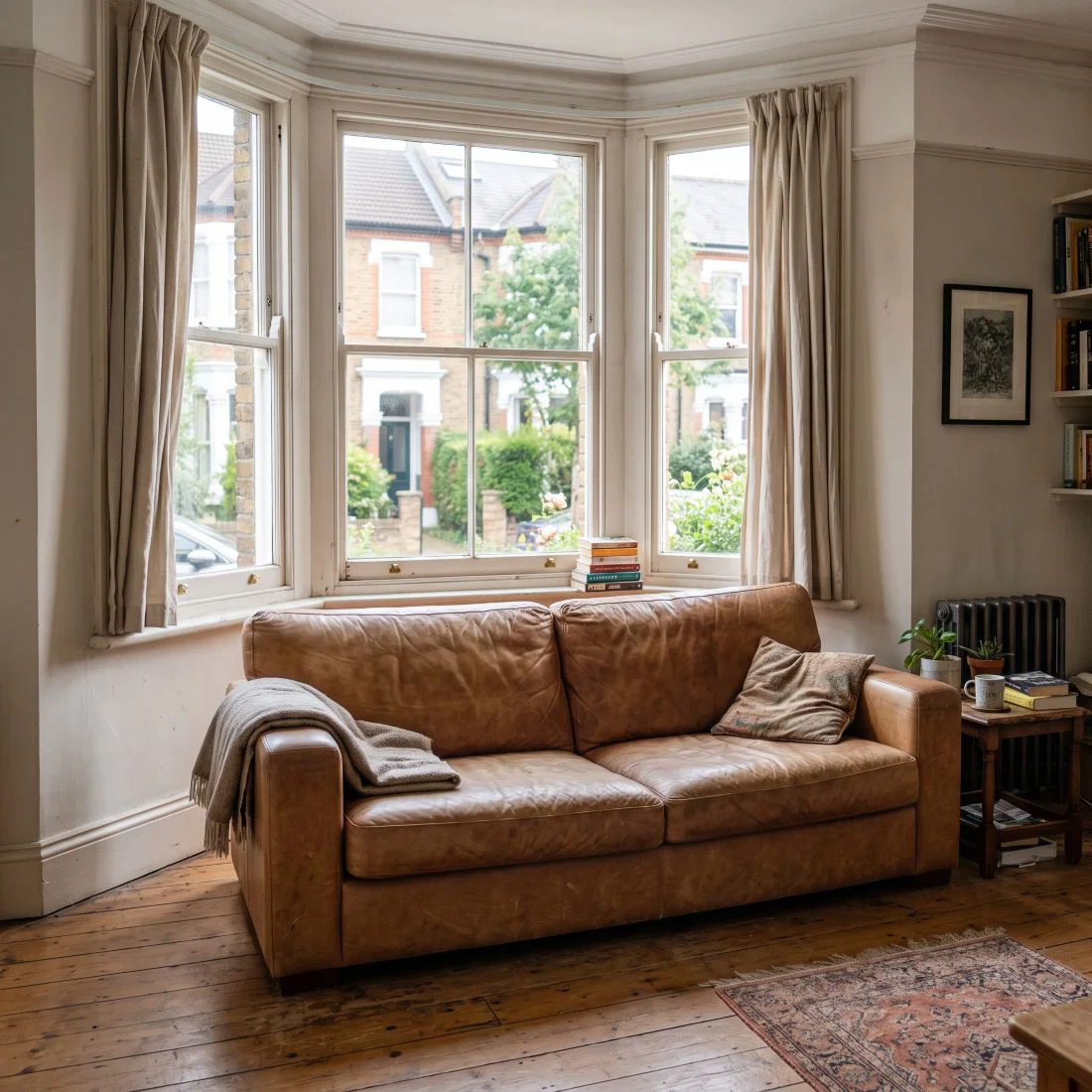
The sofa on Cole Park Road had been in the bay for eleven years. Tobacco-brown aniline hide, Italian, bought when the couple moved in, and the left arm – the arm nearest the glass – had gone the colour of a digestive biscuit. The right arm was still tobacco. On the coffee table sat a bottle of hide food from a garden centre in Whitton, half used, which explained the tacky bloom across the cushion tops and a good deal of the darkening at the seams. She wanted to know whether a professional clean would even it out. It would not. It does not come back.
That is the conversation I have most often in the Twickenham streets built between 1900 and 1930, because those houses were designed around a bay, and a bay facing south collects light for six hours a day from April to September. People put the best piece of furniture in the best light. Leather is the material that suffers most from exactly that.
What is the difference between aniline and semi-aniline hide, and why does it matter in a bay?
Aniline leather is dyed through in a drum with soluble dyes and then left alone. No pigment layer, no opaque topcoat. What you see is hide – the grain, the growth marks, the odd fly bite or scar the tannery decided to leave in – and the colour sits inside the fibre structure rather than on top of it. Anilines feel warm and slightly dry to the palm. They darken in the hand within a second or two of a wet fingertip touching them.
Semi-aniline is the same drum-dyed hide with a thin pigmented finish sprayed over it, usually with matched dye in the coating so it stays translucent. You keep most of the character and lose some of the depth. Most sofas sold here as “leather” are neither. They are corrected-grain pigmented hides with a polyurethane finish thick enough to be sanded and embossed, which is why they wipe clean, and why they crack across the seat front at year seven when the finish fatigues.
The relevance to a south bay is direct. A pigmented finish carries UV absorbers and takes the beating on behalf of the hide underneath. Aniline has no such layer. The dye is exposed, and the fatliquors that keep the fibre bundles sliding over one another sit within a millimetre of the surface, where the heat gets at them.
How to tell which one you own without sending a sample anywhere
Find an unseen patch – the outside back, low down. Put one drop of water on it and watch. Aniline drinks it in and goes dark at once, then dries back over ten minutes, often with a faint ring. Semi-aniline takes fifteen or twenty seconds to darken. Pigmented hide beads it and holds the drop until you wipe it off.
Then look at the grain across a whole cushion. Real variation – lighter and darker zones, pores of differing size – means aniline or something close to it. Uniform pebbling that repeats every few centimetres is an embossed plate on corrected grain.
Why does the sun take the colour out and the oil with it?
Two separate failures happen at once and people treat them as one.
The colour loss is photochemical. Dye molecules absorb light energy and their chromophores break down, which is irreversible. Ordinary glazing blocks most UV-B and passes much of the UV-A band, so the sash window in a Strawberry Hill bay filters a fraction of the wavelengths that matter and lets the rest through onto the arm of your sofa. Visible light does a share of the fading as well, which is the part the window-film salesmen skate over. A film rated at ninety-nine per cent UV rejection slows the process. It will not stop it.
The drying is thermal. Chrome-tanned hide is lubricated at the tannery with fatliquors – emulsified oils driven into the fibre structure so the collagen bundles stay flexible against one another. Heat brings those oils to the surface and oxidises them. A dark leather panel behind south-facing glass on a still July afternoon in TW1 sits far above room temperature; put a cheap infrared thermometer on it at three o’clock and you will get a number that surprises you. Over years the bundles lose their lubricant and stiffen, the hand goes papery, and the flex points crack – the front edge of a seat cushion, the crease over an arm roll – because the hide is being asked to bend a material that has gone rigid.
The radiator underneath the bay
Almost every Edwardian bay in Twickenham and St Margarets has a radiator under the window, because that is where the pipework went and nobody has moved it since. The same panel of hide gets solar gain from April to September and dry radiant heat from October to March. Relative humidity in a heated front room drops to the low thirties in a cold snap. Leather is happiest between forty and fifty-five.
Twelve months of that with no rest is the reason a sofa can look four years older on one side than the other by its fifth birthday.
Can restorative cleaning bring a faded aniline back?
A clean removes what sits on the leather. Body oils from head and hand contact, cooking grease, the grey film that lands on every horizontal surface in a house near the A316, and – on a great many sofas I see – the residue of whatever the owner has been rubbing in. Take that off and an aniline often looks dramatically better, because the dulling film was doing more damage to the appearance than the fade was.
What no clean does is put dye back. The faded arm stays faded. Anyone who says otherwise is describing a re-colour, which is a different job.
Here is where I part company with much of the trade. The standard answer to sun fade on aniline is a pigmented colourant sprayed over the panel and sealed. It looks superb on the day. It also turns a breathable aniline sofa into a painted one – the hand goes plasticky, the grain fills, and the depth of colour you paid five thousand pounds for is now a film on the surface that will wear off the seat front in two or three years. I will not do it to a good hide. If somebody wants it done to theirs I send them to a re-finisher who does it well, and I tell them the sofa will not be aniline afterwards.
Where re-dyeing is honest
Transparent aniline dye, applied to a whole panel by a specialist and re-fatted afterwards, is legitimate work. It suits a hide that has faded evenly rather than in a hard-edged band, and it works best going darker. Nobody has ever brought a bleached cream aniline back to cream.
What does a safe restorative clean on aniline involve?
Low moisture, whole panels, pH discipline. Leather likes to be mildly acidic, around 4.5 to 5.5, roughly where chrome tanning leaves it. Alkaline cleaners swell the fibre and strip the fatliquor. A washing-up-liquid solution at pH 9 takes grease off beautifully and hands you a stiff, thirsty panel a fortnight later.
The method: vacuum with a soft brush first, and get well into the seams. Test on the skirt for dye transfer – aniline will often tint a white cloth slightly, and a little is normal, a lot means stop. Work a pH-balanced leather cleaner into a barely damp microfibre, never onto the hide, and clean an entire panel edge to edge in one go. Spot-cleaning aniline is how you produce a clean ring inside a dirty panel, which is worse than the dirt.
Then feed it, and feed it with the right thing. A water-based fatliquor emulsion, applied thin, buffed, left overnight. Not neatsfoot oil, not mink oil, not the waxy solvent-heavy “hide food” from the garden centre in Whitton, which darkens blotchily, stays tacky, and glues airborne dust to the surface for the rest of the sofa’s life. That bottle has cost my customers more money than all the dogs in Marble Hill Park put together.
Water rings, and why the panel decides
An aniline that has taken a splash shows a dark patch that dries to a light-edged ring, because the water carries dissolved matter to the perimeter as it evaporates. The repair is to wet the whole panel evenly with a light mist and letting it dry slowly and flat, away from a heat source. The first time you do it your nerve goes. It works far more often than it fails.
What should you change in the room, rather than in the sofa?
Move the sofa. That is the whole answer, and I would rather say it than sell an annual maintenance clean to a hide that is dying of exposure.
Short of that: rotate the seat and back cushions every two months so no single face takes all the light, which on a fixed-cushion sofa means accepting that one arm will go and planning for it. Hang a lined curtain or fit a blind and close it on the bright afternoons when the room is empty. Interlined curtains help more than lined, and if your existing pair is silk and south-facing, check the lining for sun rot along the leading edge before you send anything to be cleaned – I have opened a bag in Teddington to find the lining had turned to powder in the folds, and no cleaner in London can be blamed for that.
Solar film earns its money on a modern extension with a wide south elevation. On original sash glazing in a conservation area, ask the council before anyone touches the glass.
Feed often, clean seldom
A hide in a south bay wants feeding twice a year and cleaning no more than every eighteen months. More cleaning is not better. Each clean lifts a little fatliquor along with the soil, and a sofa scrubbed every spring by an enthusiastic owner with a supermarket wipe ages faster than one left alone. Sun damage is the one form of wear that no service interval touches, and it does not come back.
The Cole Park Road sofa is still in the bay. She had it cleaned and fed, moved the standard lamp, hung an interlined curtain, and turned the sofa through ninety degrees so the faded arm faces the fireplace. It looks well. The arm is still the colour of a digestive biscuit, and it does not come back.