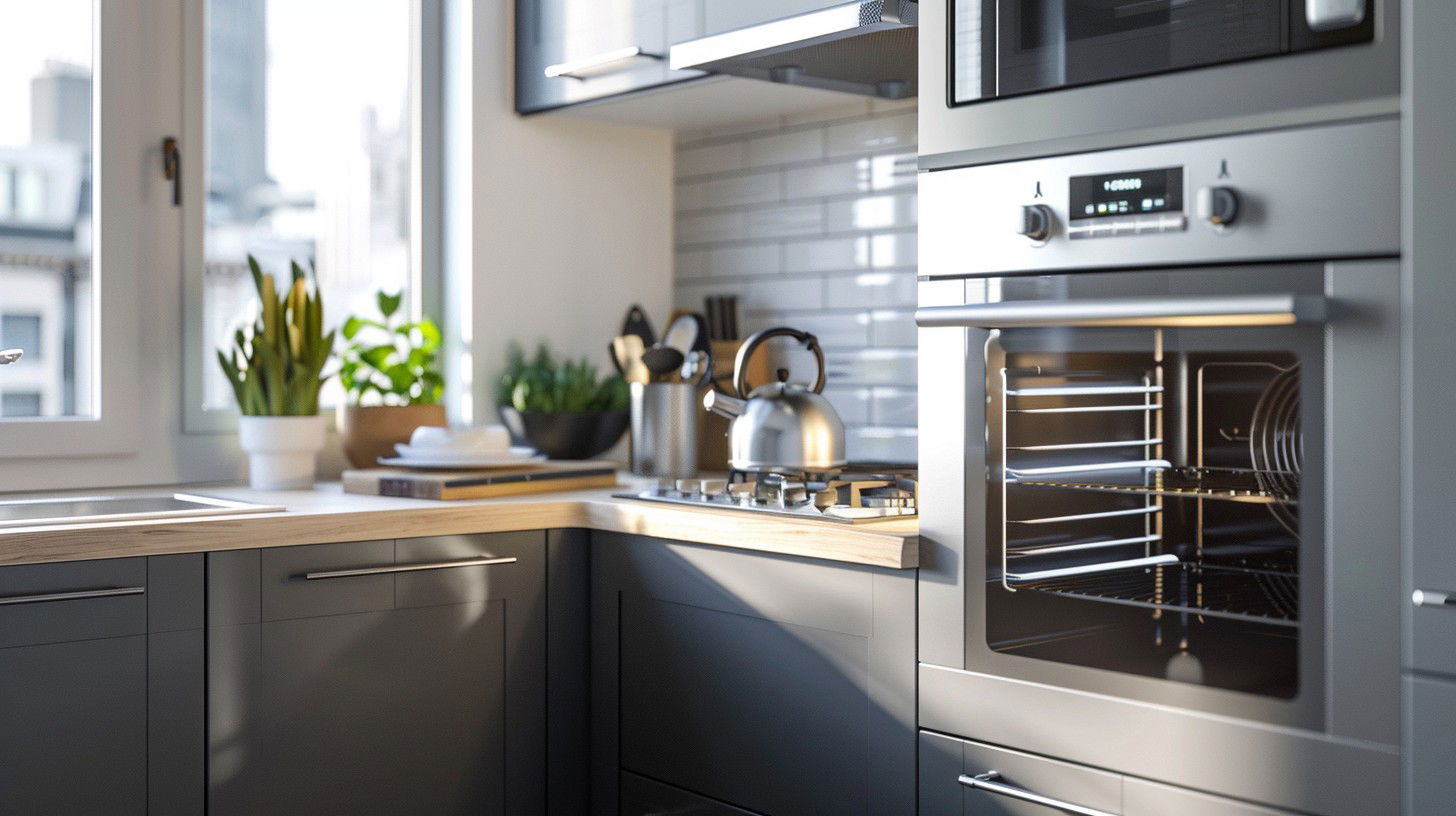
The oven on Osbaldeston Road was three years old and the owner had run the pyrolytic cycle twice, both times the week before a dinner party. Inside, the cavity was pale grey and perfect. You could have eaten off the floor of it. The door glass had a brown film across the whole lower two-thirds, thick enough that the interior light came through it the colour of weak tea, and between the middle and outer panes there was a run of something dark that had dried in a teardrop shape at the bottom corner. He had assumed the cycle handled all of it. He had paid for a machine that told him it cleaned itself, and it did, and he was standing in front of the part it had never touched.
I get called to pyrolytic ovens more often than to any other kind. The cavity is spotless every time. The cycle burns what it can see.
What is your oven doing when it cleans itself?
Two entirely separate technologies share the label, and the difference between them is the difference between a controlled fire and a slow chemical sponge.
Pyrolysis is the fire. The door locks, the element and the fan drive the cavity to somewhere in the region of 450 to 500 degrees, and it holds there for anything from ninety minutes to three hours depending on the setting. Organic soil at that temperature stops being grease and becomes carbon and gas. What is left is a fine pale ash you lift out with a damp cloth in under a minute. The engineering is good and the result inside the cavity is better than anything I can do by hand.
Catalytic is the sponge. The rough, matt panels on the side walls of some mid-range ovens are coated with a porous oxide that absorbs fat and oxidises it during ordinary cooking above about 200 degrees. No cycle, no locked door, nothing to press.
I will say plainly what most of the trade will not: catalytic liners are close to useless in a normal household. They need the oven run hot and often to work at all, they saturate, and by the time somebody notices they have stopped absorbing anything the panels have been passengers for two years. A replacement set costs sixty to ninety pounds and I would spend that on almost anything else.
Which one you have, without finding the manual
Look at the side walls. Smooth vitreous enamel that reflects the light means pyrolytic or plain. Rough, sandy, matt panels that look like unglazed pottery means catalytic liners.
Then look for a locking mechanism on the door and a control setting with a time attached to it. Pyrolysis needs a lock, because the door reaches temperatures that would take skin off. No lock, no pyrolysis.
Why does the door come out of the cycle looking worse than the oven?
Because the door is barely inside the oven. It is the wall the heat is trying to escape through, and it is built to shed that heat rather than hold it.
A modern pyrolytic door has three panes, sometimes four, with air gaps between them and low-emissivity coatings on the inner faces. That stack exists so the outer surface stays cool enough to touch while the cavity runs at 480. The consequence is that the inner glass sits substantially cooler than the cavity walls during the cycle – hot, yes, but not necessarily hot enough to carbonise a thick lacquered deposit of baked-on fat all the way through. What comes off partly turns to ash and the rest stays as a brown varnish, and the varnish has now been baked one more time and is harder than it was before you started.
Every pyrolytic clean makes the door glass slightly more difficult. That is the trade nobody mentions.
The gap between the panes
Grease gets in there through the vent slots along the top edge of the door. Steam from a roasting tin carries fat, the fat condenses on the cooler inner face of the outer pane, and it runs down and pools at the bottom corner where it dries in a streak. Nothing you can do from outside will reach it.
On most ovens made in the last fifteen years the door comes apart. Open it fully, lift the two catches on the hinges, close it onto the catches, lift the whole door off the hinge arms, then take out four to six screws along the top edge and slide the panes free. Twenty minutes if you have never done it, ten thereafter, and it is the single most transformative thing you can do to an oven that looks tired. Photograph each pane as it comes out. They have a right way round and a coated face, and they are not interchangeable.
What has to come out before you press the button?
Everything. The shelves, the side runners if the manual says so, the telescopic rails without exception, the baking tray you have been storing in there, the meat probe, the foil.
Chrome-plated shelves discolour at pyrolytic temperatures. They come out looking bronzed and slightly matt and they do not come back. Some manufacturers now sell shelves rated to stay in – they say so explicitly in the manual and they are usually a duller grey finish rather than bright chrome. If the manual does not say it, take them out.
Telescopic runners are the expensive mistake. The ball races inside them carry a high-temperature grease that migrates out at 480, and after a couple of cycles they go from a smooth glide to a grinding drag. A replacement pair for a mid-range oven runs to well over a hundred pounds.
The bath, and what I would rather you did not pay me for
Here is the part of my own trade I think is oversold. The single most common thing people book an oven clean for is a set of blackened shelves, and a dip tank makes them beautiful, and I charge for it.
You can get ninety per cent of that result in your own bath for about forty pence. Line the bath with an old towel so the enamel does not get scratched, lay the shelves flat, cover them with the hottest water the tap gives, and add a large squeeze of washing-up liquid and half a cup of soda crystals. Leave it overnight. In the morning most of the carbon lifts with a green scourer and very little effort. Soda crystals, not bicarbonate – they are a stronger alkali and they cost a pound a kilo in the supermarket.
If your shelves are the only problem with your oven, do that instead of calling anybody.
What does the cycle cost you?
More than people assume, in three currencies.
Electricity first. A full three-hour pyrolytic cycle on a 3kW oven does not draw full power throughout, since most of the time is spent holding temperature rather than climbing to it, but a realistic figure is somewhere around three to four units of electricity per cycle. Run it monthly and it is a modest line on the bill. Run it weekly out of enthusiasm and it stops being modest.
Wear second. The cavity enamel, the door hinges and the fan bearings all live through a temperature excursion far beyond anything cooking asks of them. Ovens are built for it. They are not improved by it.
Smoke third, and this is the one that catches people out in a flat. A cycle run on a heavily soiled oven produces a volume of acrid smoke that will set off a hallway detector and hang in soft furnishings for a day. Open every window on that side of the building. If there is a bird in the flat, put it somewhere else entirely – in a converted house on Cazenove Road that means a neighbour’s, not the next room.
Run it dirty and it goes badly
The instinct is to save the cycle up until the oven is filthy, which is precisely wrong. A light soil turns to a teaspoon of ash. A heavy one smokes for two hours and can leave a sticky brown condensate around the door frame that was not there before.
Every four to six weeks on an oven in regular use, and stop the moment a spill happens rather than waiting for the calendar.
So what is worth paying somebody for?
A pyrolytic oven with a door you strip yourself twice a year does not need me at all, and I would rather say that than take an annual booking from somebody whose cavity is already clean. There is nothing for me to do in there. The cycle burns what it can see, and it sees the cavity.
What I am useful for is the rest. Fan housings that have accumulated grease behind the back panel, which needs the panel off and the fan out. Doors that have been left long enough that the varnish on the inner glass no longer responds to a paste and needs a proper caustic gel and a controlled dwell. Extractor canopies and hob surrounds, which sit above the oven and which no cycle of any kind reaches. Ranges with no self-cleaning function at all, which is most of the older kit in Walthamstow and Leyton conversions.
The one job people leave far too long
The rubber seal round the cavity opening. It survives pyrolysis, it is not supposed to be scrubbed, and it collects a soft grey grease along its lower run that people wipe at with a caustic cloth and slowly destroy. Warm water, mild detergent, a soft cloth, no pressure. Check the corners for a hardened section that no longer springs back when you press it, because a seal that has gone rigid is letting heat past the door and pushing your cooking times out without ever announcing itself. They cost thirty pounds and they clip on.
The man on Osbaldeston Road strips his own door now. He sent me a photograph of the panes drying on his kitchen table, standing in a row like records, and asked whether he had done it right. He had. His cavity is still perfect, because the cycle burns what it can see.