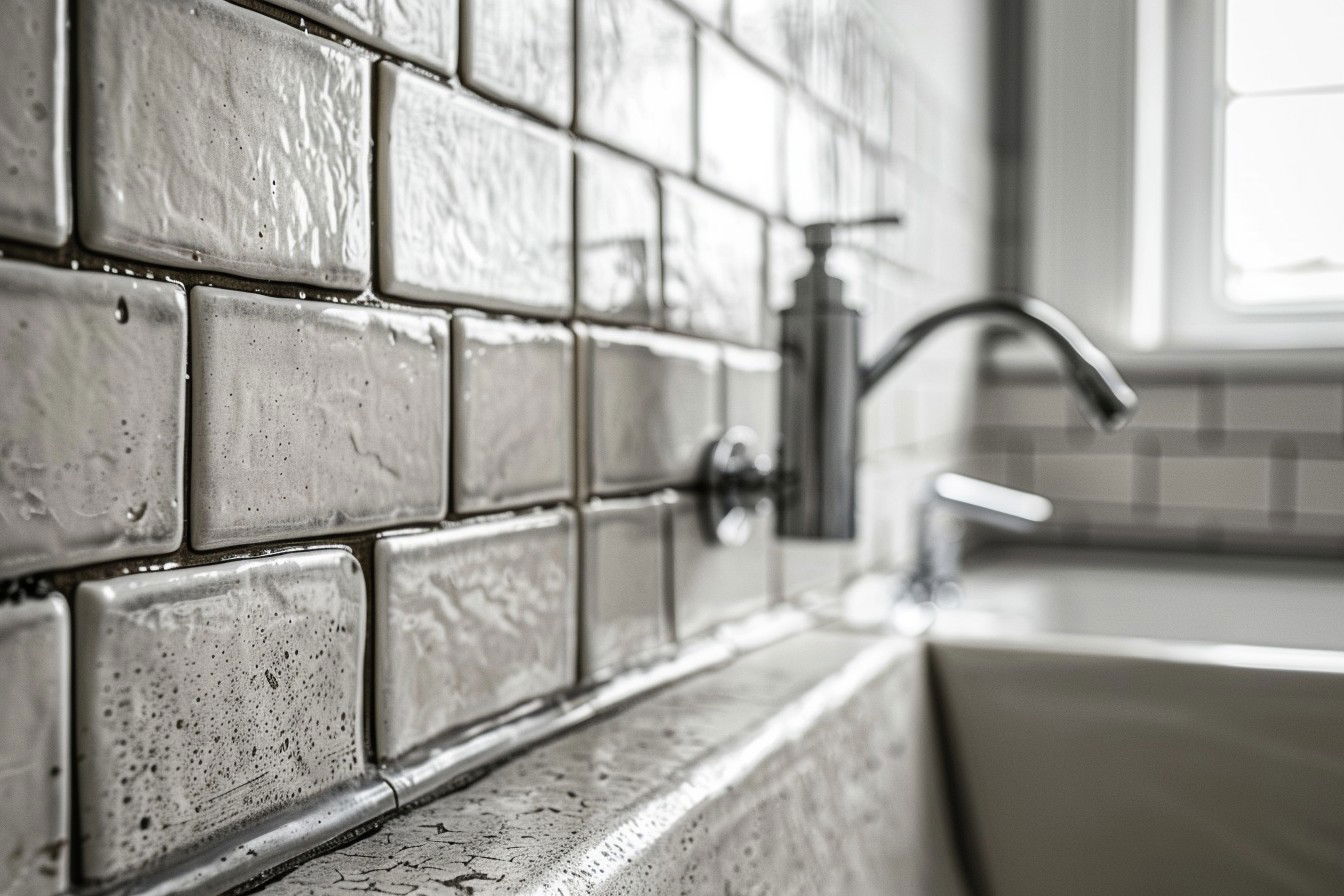
The shower on Bathurst Gardens had white grout when it went in, eight years ago, and the tenant’s photographs made it look like somebody had drawn over every joint with a tea-stained finger. Darkest along the bottom three courses. Almost clean at head height. The landlord had already been quoted for a full re-tile by somebody who had looked at the same photographs and decided the tiling was finished.
It was not finished. It took me two hours and a cup of soda crystals, and the grout came back to something within a shade of the original. What made the difference was knowing what the brown was, because grout is cement and cement behaves in ways that no amount of scrubbing will overrule.
That job is the exception, though. Half the brown grout I am sent photographs of has stopped being a cleaning problem some years earlier.
What is the brown made of?
Four things, usually all at once, and they respond to entirely different treatments.
Soap scum makes up most of it. Fatty acids in soap react with the calcium and magnesium in London’s water to form calcium stearate, an insoluble waxy salt that will not dissolve in water and does not care how hard you rub. It builds in thin layers. Each layer traps body oil and shampoo residue, and the deposit goes from white to grey to a translucent tan over a couple of years.
Then limescale, from the same hard water, laid down wherever a drop sits and evaporates. Then iron, if the property has any run of old steel pipework left in it, which stains a distinct orange-brown and concentrates at the lowest point of the shower.
And biofilm. Bacteria and yeasts living in the moisture the grout holds, producing a pink or grey-brown discolouration that regrows within a fortnight of any clean that kills it without removing what it was eating.
The thumbnail test
Run a thumbnail hard along a brown joint. If you feel the nail catch a surface and come away with a smear of something on it, you have deposit sitting on top of sound grout, and it will clean.
If the nail sinks slightly and brings out a small quantity of grey powder, the grout has lost its binder and is eroding. Harder scrubbing only makes the erosion faster. What that joint needs is raking out to two or three millimetres and refilling, which is a morning’s work with a grout saw and a bag of powder, and it costs about eleven pounds in materials.
Try it in three places: the bottom course of the shower, a wall at shoulder height, then the floor beside the bath. They are often in three different conditions, and the bottom course is almost always the worst of them, because that is where the water sits longest and where the soap concentration in the run-off is highest.
Why do bleach and limescale spray both fail?
They fail for opposite reasons, and between them they account for most of the wasted effort I hear about.
Household bleach is a bleaching agent, and what bleaching does is decolourise. It attacks the chromophores in a stain and leaves the deposit sitting there, colourless. Your grout looks better for about ten days. The calcium stearate is still there, still holding water and organic matter, and the discolouration returns because nothing was ever taken off the surface. On black spotting in silicone, bleach works even less well than that, for reasons I will come to.
Limescale sprays fail more expensively. They are acidic, usually sulphamic or a strong citric formulation, and grout is cement. Acid attacks the calcium carbonate and the calcium silicate hydrate that hold cementitious grout together. A strong descaler left to dwell on a grout line etches it, opens the pore structure, and produces a joint that soils faster and looks worse within two months than it did before treatment.
People then conclude the grout is beyond saving, and by that point they are not wrong.
The pH that does the work
Soap scum is an alkaline problem. A degreaser at pH 10 to 11 saponifies the fatty deposit and lifts it off the surface, which is what soda crystals in hot water do at a fraction of the price of anything sold in a bottle for the purpose.
A cup of soda crystals to two litres of water as hot as your hands will take through a glove. It wants dwell time – fifteen minutes minimum, longer on a bad wall, kept wet with a second application halfway through. Then agitation with a stiff nylon brush along the joint rather than across it.
Save the acid for the tile faces afterwards, if the tiles are porcelain or ceramic, and keep it off the joints. On natural stone, no acid at all, ever.
What sequence brings brown grout back?
Order matters more than product choice here.
Strip the grease first with the alkali. Rinse it thoroughly, because any residue left behind will neutralise whatever comes next and leave a faint bloom when it dries.
Then oxygen bleach on what remains. Sodium percarbonate, dissolved in warm water at roughly a heaped tablespoon per litre, brushed on and left for twenty to thirty minutes without drying out. This is the step that deals with the biofilm and the last of the organic staining, and it works slowly and steadily rather than dramatically. It will not damage cement. A cheap tub of laundry oxygen booster from any supermarket is the same compound as the branded grout products at a quarter of the cost.
Rinse again, dry the wall with a towel, and look at it in daylight rather than under a downlight. Downlights rake across a wall at a shallow angle and make every joint look worse than it is.
Iron staining, if any survives, needs an oxalic or reducing-type rust remover applied to the specific spots. It is mildly acidic, so it goes on for two or three minutes and comes straight off.
Steam, and where it stops
A steam cleaner with a brass detail brush is the most effective single tool for this job. Heat and mechanical action, no chemistry, and it reaches the pore structure in a way that a wiped surface cleaner never does.
What it will not do is remove calcium stearate on its own. Steam a greasy wall and you soften the deposit, redistribute it, and drive some of it deeper. Degrease first, steam second. That order round, the steam does perhaps a third of the total work in a quarter of the time.
Steam also strips the surface off failing grout with startling efficiency, which is another reason for the thumbnail test before anybody switches anything on.
What about the black stuff in the corners?
That is a different material and no cleaning method reaches it.
The junctions – wall to tray, wall to wall, wall to bath – are silicone sealant rather than grout, because those joints move and cement cannot. Mould in silicone grows into the body of the sealant, not on it. Bleach decolourises the surface layer and the hyphae underneath carry on. Two weeks later it is back, slightly worse, and somebody has spent a fortnight convinced they have a persistent bathroom problem when what they have is a consumable at the end of its life.
I will not sell anybody a silicone clean. There is no such thing that lasts. Replace the run.
Replacing a run of sealant
Cut both edges with a fresh blade, pull the old bead out in one length if you can, then scrape the residue back to clean substrate. Wipe with methylated spirit and let it dry completely, because silicone will not bond to a damp or greasy face.
Fill the bath with water before you seal it, and leave it full until the silicone has skinned. A bath deflects under load and a bead applied to an empty bath tears along its top edge the first time somebody gets in.
Use a sanitary-grade silicone with a fungicide. Six pounds a tube, one tube does a standard bathroom, and the whole job is an afternoon. Anyone charging you a hundred and twenty for it is charging for not having to do it yourself, which is a legitimate thing to pay for as long as you know that is what it is.
Is sealing grout worth the trouble afterwards?
Yes, and it is oversold at the same time.
An impregnating sealer soaks into the pore structure and leaves a hydrophobic layer inside it. Water beads, soap scum sits on the surface rather than in it, and a weekly wipe keeps a wall looking new for far longer. On a shower that gets daily use it wants redoing every eighteen months to two years, and the honest test is whether water still beads on the joint. If it darkens instead, reseal.
Where the trade oversells is frequency and product. Annual resealing on a lightly used bathroom is unnecessary, a topical acrylic sealer that sits on the surface will peel and go cloudy, and a fifteen-pound bottle of impregnator does an entire bathroom with plenty left over.
The advice that costs me a booking
If your grout has lost its surface, no deep clean is worth buying. I have talked landlords in Kensal Rise and Acton out of three-hour grout jobs and told them to spend a morning with a grout saw instead, because I would rather lose the fee than take money for scrubbing a joint that is eroding while I scrub it.
The tell is the powder on the thumbnail, and it takes ten seconds to check. The photographs from Bathurst Gardens showed deposit rather than erosion, which is why that shower is still in service and the re-tile quote went in the bin. Grout is cement. It will hold whatever gets into it, and it will let most of it go again if the surface is still there.